
I'm starting the year by sharing a new series of encaustic paintings; Nature's Alchemy.
I'm starting the year by sharing a new series of encaustic paintings; Nature's Alchemy.

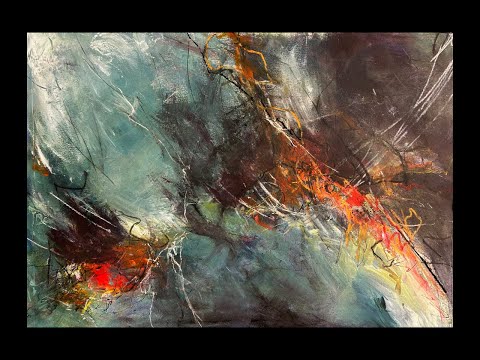
I'm delighted to share my painting Sediment of Blues as part of We've All Got the Blues, a travelling exhibition (2025–26) and collaboration between ten OCA student artists across the UK, Sweden, and Iceland.

I'm delighted to share that I'll be participating in Julkonst 2025 at Galleri Karantänen in Helsingborg, organised by Helsingborgs Konstförening.
The exhibition runs 29 November – 7 December 2025, open Saturday–Sunday, 13–16.

I have been slowly settling into my temporary art studio, the dining room of our main house, while I dream and plan a future studio in one of the old stables.

After an enriching and inspiring residency at Nebbeboda Skola, life took a big turn!

Spending two wonderful weeks at Nebbeboda Skola has come to an end and I feel deeply grateful to Olofström's Municipality, the Harry Martinson Society, and the Salje Society for making it possible.

In my pigment garden, there are few plants that are as full of quiet drama as woad. I'm completely captivated by its astonishing transformation.

I'm thrilled to share that one of my paintings has been selected for the 2025 National Juried Exhibition organised by the Swedish Artist Association SK. The exhibition will take place at Strandverket, Marstrand, from July 26 to August 3.

I am so excited that two of my Autumn Equinox monotype prints have been selected for the juried exhibition Kullasalongen at Krapperups Konsthall!

I'm so thrilled and honoured to be invited for a cross-border artist collaboration between Sweden and Denmark!

As we prepared to say goodbye to our Christmas tree earlier this year, a thought struck me—could I perhaps extract any color from the nails?

I was lucky enough to spend some time in Norway over the New Year holiday. The cottage we stayed in was nestled between a lake and a forest—an absolute dream for a pigment maker!

Growing dye plants has a rich history in Sweden, where plants like woad (Isatis tinctoria), madder (Rubia tinctorum), and weld (Reseda luteola) were traditionally used to produce blue, red, and yellow dyes. During the 18th and 19th centuries, natural sources such as roots, berries, bark, leaves, lichens, and later even fungi were also used...

I am so thrilled that my artwork 'In Every Soul there's a Shore' / 'I Varje Själ Finns en Strand' has been chosen to be part of the juried exhibition Vintersalong 2024 at Nacka Konsthall, Sweden.
I am thrilled to have my digital collage and poem included in Kel Portman's Autumn Equinox Project- an assemblage video showcasing artworks created on the event of the autumn equinox 2024.

On the note of 'Nothing gold can stay' from my earlier blog post... this weekend I took a walk in Staffanstorp to see if the wonderful Tansy flowers I had found earlier this summer were still in bloom.

My Autumn Equinox Walk is finally published!

I love the arrival of autumn with its rich, deep hues. There's something grand about walking through a landscape illuminated with fiery reds and striking yellows.

I am noticing the incredible amount of rich and deep hues surrounding me on my daily walks at the moment. At a particular spot on my ritualistic walk, there is a maple tree, and today, countless leaves had fallen, colouring the entire ground red! It was glowing, as if I were walking on fire!

Morning dew glimmers,
Revealing delicate webs,
Autumn breathes again.
- © Therese Livonne
